
There was a time when starting a serious business meant hiring employees, renting office space, buying expensive equipment, and preparing yourself for the wonderful adventure of managing other people’s problems.
Today, someone with a laptop, an internet connection, and a good idea can build a business that reaches customers around the world.
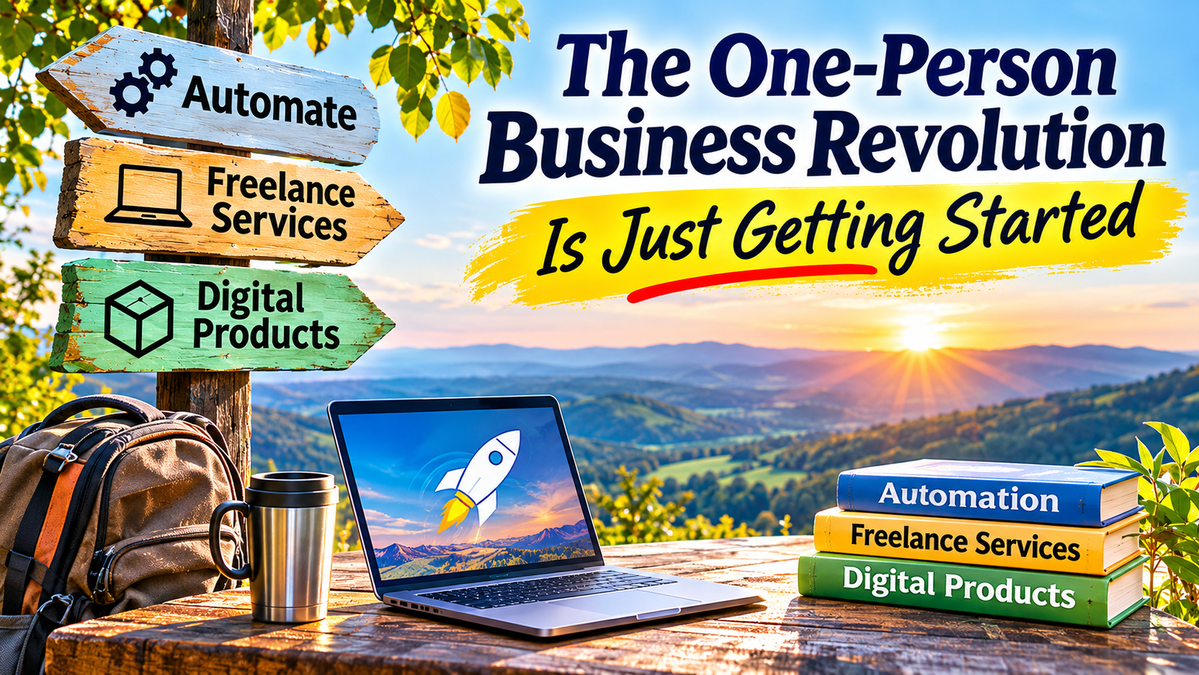
No office lease. No payroll department. No Monday morning staff meetings where everyone pretends to be excited about the new filing system.
Just one person building something worthwhile.
And here’s the interesting part: we’re probably still in the early stages of what one-person businesses can become.
A remarkable combination of automation, artificial intelligence, freelance marketplaces, and digital products is changing what’s possible for independent entrepreneurs.
The question is no longer whether one person can operate a real business.
It’s how much one person can accomplish without turning that business into a full-time management headache.
Small Business Is Getting a Whole New Meaning
For generations, business growth followed a familiar pattern.
You started small, attracted customers, got busier, hired employees, expanded your operations, and hopefully earned enough money to make the additional responsibilities worthwhile.
More business usually meant more people.
But that relationship is beginning to change.
A freelance designer can now manage appointments, send proposals, collect payments, deliver projects, and follow up with customers using a collection of relatively inexpensive online tools.
A writer can publish articles, sell digital guides, operate a newsletter, and earn affiliate commissions without hiring a publishing team.
A consultant can build a specialized service business serving clients across multiple countries without ever opening a physical office.
These aren’t necessarily businesses with millions of dollars in revenue. Many are modest operations providing a comfortable living.
And that’s an important distinction.
A successful business doesn’t have to become a large business.
For some entrepreneurs, the ultimate achievement isn’t having 50 employees. It’s having enough income, independence, and flexibility to enjoy life without constantly worrying about the next paycheck.
That’s a very different definition of success.
Automation Is Becoming the Invisible Employee
Imagine running a business where new customers can discover your services, schedule an appointment, receive a confirmation, make a payment, and get a follow-up message without you personally handling every step.
Not long ago, coordinating all those activities might have required an assistant or administrative employee.
Today, much of that work can be automated.
Email marketing platforms can welcome new subscribers and deliver educational messages over several weeks.
Scheduling tools can eliminate the endless back-and-forth of arranging appointments.
Payment systems can generate invoices, process transactions, and send receipts.
Website platforms can handle product delivery, customer registration, and basic support information.
Artificial intelligence adds another layer, helping entrepreneurs brainstorm ideas, organize research, draft content, analyze information, and tackle routine tasks.
None of these tools eliminates the need for human judgment.
In fact, that’s where things get interesting.
The entrepreneur who learns to combine technology with good judgment gains an advantage over someone who simply automates everything and hopes for the best.
Automation should remove repetitive work so you can spend more time doing the things that actually matter.
Building relationships. Understanding customers. Improving your products. Thinking creatively.
Those are the activities that can make a small business valuable.
Freelancing Is Becoming a Business Launchpad
One of the easiest ways to begin a one-person business is to sell a skill you already have.
Writing, editing, graphic design, bookkeeping, website development, tutoring, consulting, video editing, and social media management are just a few possibilities.
You don’t necessarily need to invent a revolutionary product.
You need to solve a problem that someone is willing to pay you to solve.
But there’s an important difference between being a freelancer and building a sustainable freelance business.
A freelancer who charges by the hour may eventually hit a ceiling. There are only so many hours available, and spending all of them working leaves little room for growth.
A business-minded freelancer looks for ways to make the work more efficient, valuable, and repeatable.
Consider someone who creates websites for local businesses.
Instead of quoting every project from scratch, they might develop three clearly defined service packages.
They could use templates for common website layouts, automate client onboarding, standardize the information they collect, and establish a predictable delivery process.
The customer still receives a customized service.
But the entrepreneur isn’t reinventing the wheel every Monday morning.
Over time, that freelancer might introduce website maintenance plans, content updates, or other recurring services.
Now they’re building something more durable than a collection of individual jobs.
They’re developing a business system.
Digital Products Change the Equation
Services are a great starting point because customers pay for your time and expertise.
Digital products introduce another possibility: creating something once and selling it repeatedly.
Think about a photographer who sells downloadable editing presets.
A fitness instructor who creates a specialized workout guide.
A financial educator who develops budgeting spreadsheets.
Or a marketing consultant who packages useful templates for small-business owners.
These products don’t require physical inventory, shipping departments, or warehouse space.
Once created, they can often be delivered automatically.
Of course, the phrase “create once, sell forever” makes the process sound considerably easier than it usually is.
Digital products still need marketing, customer support, occasional updates, and, most importantly, a reason for people to buy them.
A beautifully designed downloadable guide that nobody needs isn’t a business. It’s a very attractive file sitting on a server.
The opportunity comes from understanding a specific audience and creating something genuinely useful.
And there’s another advantage.
Digital products can complement an existing service business.
A freelance writer might sell content planning templates. A website designer might offer downloadable branding resources. A tutor might create study materials.
Each product becomes another way to serve customers without adding an equivalent amount of work to every sale.
The Real Opportunity Is Combining Different Income Streams
This is where the one-person business model becomes especially interesting.
Instead of relying entirely on one activity, an entrepreneur can build several related sources of income around the same audience.
Imagine someone who helps small businesses improve their online presence.
Their primary income might come from building websites.
They could also earn recurring revenue from maintenance services, sell downloadable marketing resources, and receive affiliate commissions when customers purchase software they genuinely recommend.
Meanwhile, a helpful blog or email newsletter could attract new prospects and establish credibility.
The pieces support one another.
The website service introduces customers to the business. The newsletter keeps those relationships alive. The digital products provide additional solutions. The recurring services create more predictable revenue.
This doesn’t mean every entrepreneur should immediately launch six income streams.
Actually, that’s a pretty good way to end up with six unfinished projects.
The smarter approach is usually to establish one reliable offering, understand the customers it attracts, and gradually introduce complementary products or services.
Diversification works best when the different pieces strengthen one another rather than compete for your attention.
The One-Person Business Still Needs Other People
There’s a small contradiction hiding inside the phrase “one-person business.”
The most effective solo entrepreneurs rarely do absolutely everything themselves.
They just don’t necessarily employ a traditional team.
A business owner might hire a freelance accountant during tax season, pay a designer to create a logo, or contract a specialist to solve a technical problem.
They may use software companies to handle activities that once required internal departments.
In other words, the business remains independently owned and operated, but it draws on a much larger network of expertise and services.
This is a significant advantage.
Instead of maintaining permanent overhead for every possible business need, entrepreneurs can purchase specialized help when it makes sense.
But there’s a caution worth mentioning.
Outsourcing a task doesn’t eliminate responsibility for the result.
Someone still needs to maintain quality, protect customer information, manage expenses, and make sure the work meets expectations.
That someone is usually the business owner.
Being a solopreneur means having fewer people to manage, not having fewer decisions to make.
Freedom Doesn’t Happen Automatically
There’s a romantic version of entrepreneurship that involves answering a few emails from a beach chair while the business runs itself.
It’s a lovely picture.
It’s also a terrible business plan.
One-person businesses have some genuine vulnerabilities.
If the owner gets sick, takes a vacation, or experiences a family emergency, certain activities may stop.
If one major customer disappears, revenue can fall sharply.
And if the entrepreneur never establishes boundaries, working from home can gradually turn into working all the time.
Technology doesn’t automatically solve these problems.
Sometimes it makes them worse by allowing customers, notifications, and unfinished tasks to follow us everywhere.
That’s why building a sustainable solo business requires more than finding customers.
It means creating financial reserves, documenting important processes, maintaining dependable systems, and deciding when you’re available to work.
It also means recognizing when something isn’t worth doing.
Every new opportunity has a hidden cost: the time and attention it takes away from everything else.
The ability to say no may be one of the most underrated business skills an entrepreneur can develop.
You Don’t Need to Be a Technology Expert to Participate
One misconception about modern online businesses is that you need to understand every new software platform, AI model, and automation tool before you can get started.
You don’t.
You need a problem worth solving and a practical way to reach people who have that problem.
Everything else can develop from there.
A sensible starting point might look like this:
- Choose one audience. Identify a group of people whose needs you understand or are willing to study.
- Solve one specific problem. Offer a service or product that produces a clear, useful result.
- Find your first customers. Focus on conversations, outreach, referrals, or useful content rather than trying every marketing method at once.
- Make the process repeatable. Document what works and simplify the steps that consume unnecessary time.
- Automate selectively. Introduce tools when they solve a real bottleneck, not simply because they’re fashionable.
- Expand when the demand is there. Add complementary offerings after the original business has demonstrated that people will pay for its value.
Notice what’s missing?
You don’t need a complicated organizational chart, a massive startup budget, or a five-year plan with 47 different revenue projections.
You need to start, learn, improve, and keep moving.
The Next Generation of Entrepreneurs May Look Very Different
We’re accustomed to celebrating businesses that grow into enormous organizations.
And there’s nothing wrong with that ambition.
Large companies create jobs, develop important products, and contribute enormously to the economy.
But a different kind of entrepreneurial success is becoming increasingly practical.
Someone might operate a specialized consulting business from a small town while serving clients internationally.
Another person might combine freelance projects with educational products and a niche newsletter.
A parent might build a flexible online business around family responsibilities.
A retiree might turn decades of professional knowledge into a modest but rewarding second career.
These entrepreneurs aren’t necessarily trying to build the next billion-dollar company.
They’re building businesses designed around the lives they want to live.
That may be the most meaningful part of this revolution.
Technology is reducing some of the traditional barriers between having a useful idea and turning it into an independent source of income.
It doesn’t guarantee success. Competition is real, customers are demanding, and business ownership always involves uncertainty.
But it gives resourceful individuals more ways to participate.
And as automation tools become more accessible, the opportunities will continue to evolve.
The biggest winners won’t necessarily be the people using the most technology.
They’ll be the people who understand what customers need and use technology intelligently to deliver it.
Because the real promise of the one-person business revolution isn’t that one person can do the work of a hundred.
It’s that one person may no longer need a hundred people to build a business worth having.
And that’s a revolution worth watching.

Philllip Dawkins shares practical tips, tools, and resources to help make building income online simpler and more approachable. Through this website, Philllip provides helpful content and recommendations, including the Plug-In Profit Site, a system designed to help beginners get started online with a website, step-by-step training, and built-in income streams. Learn more about getting started with Plug-In Profit Site here.